


OK. Just One More.....


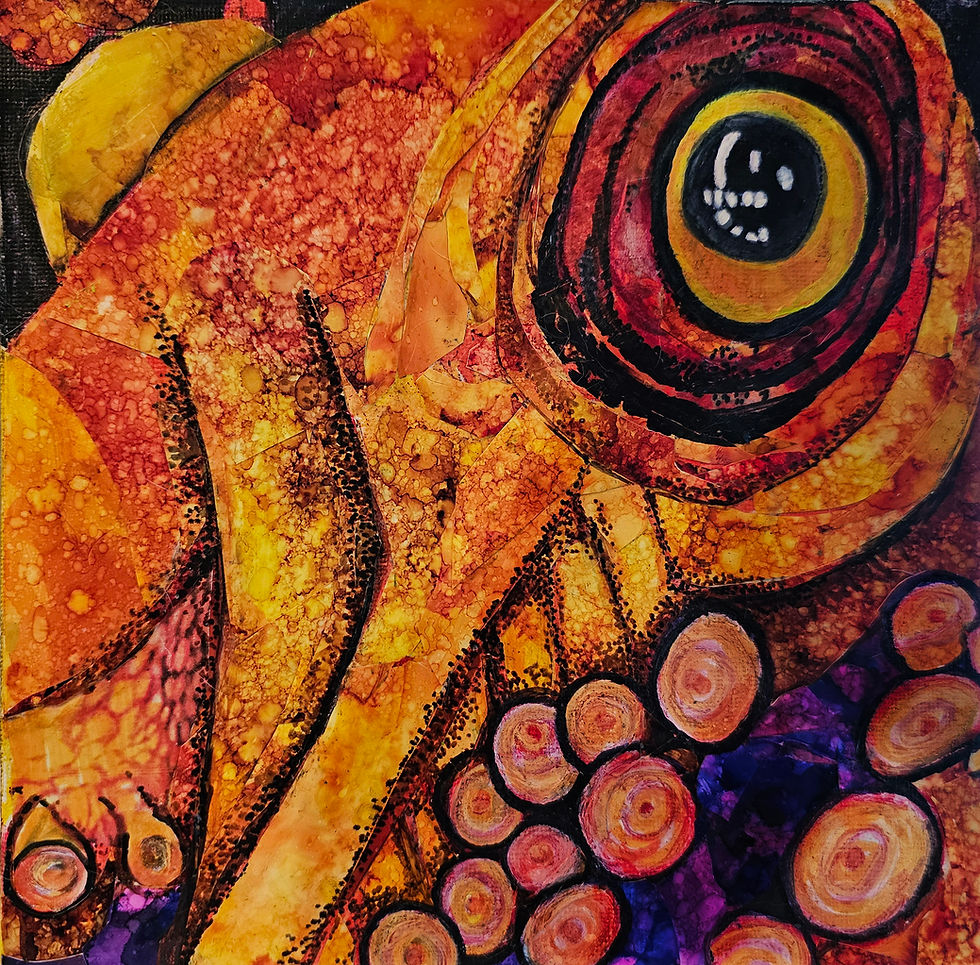
I can't quite bring myself to stop painting the octopus! I love the suction cups and the dynamism created from all those arms (or legs?) stretching across the canvas. This one is another 24" x 36" mixed media painting/collage on canvas.
The background on this one is crafted entirely from my acrylic pours and gelli monoprints. Circular found objects form the suckers.
One of the reasons I rarely do pen and ink drawings these days is because if you make a mistake (which usually occurs when you are right at the finish line) you have to start all over again. (Of course, I still have college memories spilling a bottle of india ink on my apartment's attractive orange shag carpeting and a couple of my art books.) More recently, a brain injury and failed hand surgery in my dominant hand have made it difficult to make the precise movements needed for pen and ink, and it limits the time available before my aching hand screams "ENOUGH!"
OTOH, collage and mixed media offer the flexibility to just add another layer atop any suboptimal parts of the canvas.
Here's why octopuses are amazing:
They've got large brains. They can navigate mazes, solve problems, remember, predict, use tools and take apart just about anything from a crab to a lock—all.
Octopuses can come ashore. During short nocturnal forays at low tides, a few coast-dwelling species appear to hunt for easy pickings such as crabs, shellfish and, according to some reports, harbor rats. But with their high oxygen needs, and the extreme exertion of moving their boneless bodies against gravity’s drag, they can only survive on limited gas exchange through their moist skin for a few minutes before crawling back into the sea.
About two-thirds of an octopus’s neurons are located in its arms. The arms can taste, touch, and even act on their own accord, without input from the brain.
Some research has even found that after an arm is severed from the body it will continue to snatch up food and try to move it in the direction of where the creature’s mouth used to be.
Their blood is blue.
They have three hearts.
Males only live a few months after mating. After mating the female protects and cares for eggs, and when her maternal duties are fulfilled she kicks off.
They are masters of camouflage and can change color completely in under a second.
Octopuses in captivity regularly solve puzzles, open jars, navigate obstacle courses, and even find cheeky ways to escape their tanks.
They sometimes build underwater cities.
Australia’s blue-ringed octopus is considered to be one of the world’s most venomous marine animals. Though only 5-8 inches in size, one octopus can carry enough venom to kill 26 adult humans and all within a matter of minutes. Their potent venom contains tetrodotoxin, which is 1,200 times more toxic than cyanide.
Some research has found that after an arm is severed from the body it will continue to snatch up food and try to move it in the direction of where the creature’s mouth used to be.
Octopuses can reach speeds of up to 40 km/h for short bursts.
They have both feet and arms! Six limbs function as arms and two act more like legs, helping the octopus walk along the seabed and push off when swimming.
Their official name is vampyroteuthis infernalis, which means "the vampire squid of hell”. Yet they’re living fossils, related more closely to extinct animals.


Comments